


In e-commerce, a feeling often decides what gets reordered. Is a product selling well? Is there enough stock left? When does the next order have to go out? As long as the assortment is small, going by gut works. As soon as it grows, it becomes a guessing game with real costs.
Elferspot knows this problem. As the largest marketplace for classic and pre-owned Porsche sports cars, the company also runs its own shop for Porsche enthusiasts. There you will find apparel, accessories, books, models, and much more. An assortment supplied by many small vendors, manufactories, and regional producers.
For exactly this challenge, Soneo AI built an intelligent e-commerce dashboard. A system that restores the overview and turns gut decisions into data-based decisions.
The starting point: many suppliers, little overview
The Elferspot shop lives on its variety. Products don't come from the central warehouse of a single large supplier, but from many small vendors, manufactories, and regional producers. That makes the assortment special and high-quality. But it also makes managing it demanding.
The more suppliers, the more different conditions. Every producer has their own workflows, their own quantities, their own lead times. What arrives within days from one vendor takes weeks from the next.
“A diverse assortment is an advantage in the shop window and a challenge in the backend.”
The challenge: different lead times
The real problem wasn't the variety itself, but the lack of a quick overview of how products are performing, how high the inventory is, and consequently how much needs to be reordered.
Without this overview, every reorder becomes a tightrope walk. Order too late, and the product is sold out before replenishment arrives, especially critical with long-lead-time suppliers. Order too early or too much, and you tie up capital in stock that moves slowly.
“With twenty suppliers and twenty different lead times, nobody can keep it all in their head. That's exactly where the guessing game begins.”
So far, these decisions were largely made from experience. That works as long as the person with the experience is available and the assortment stays manageable. It doesn't scale.
The solution: a dashboard that thinks along
We built an intelligent e-commerce dashboard for Elferspot that closes exactly this gap. It brings all relevant information into one place and makes visible at a glance what previously had to be painstakingly gathered.
The dashboard shows clearly how products are developing, where inventory stands, and where action is needed. Instead of working through different sources, the people in charge immediately see what matters.
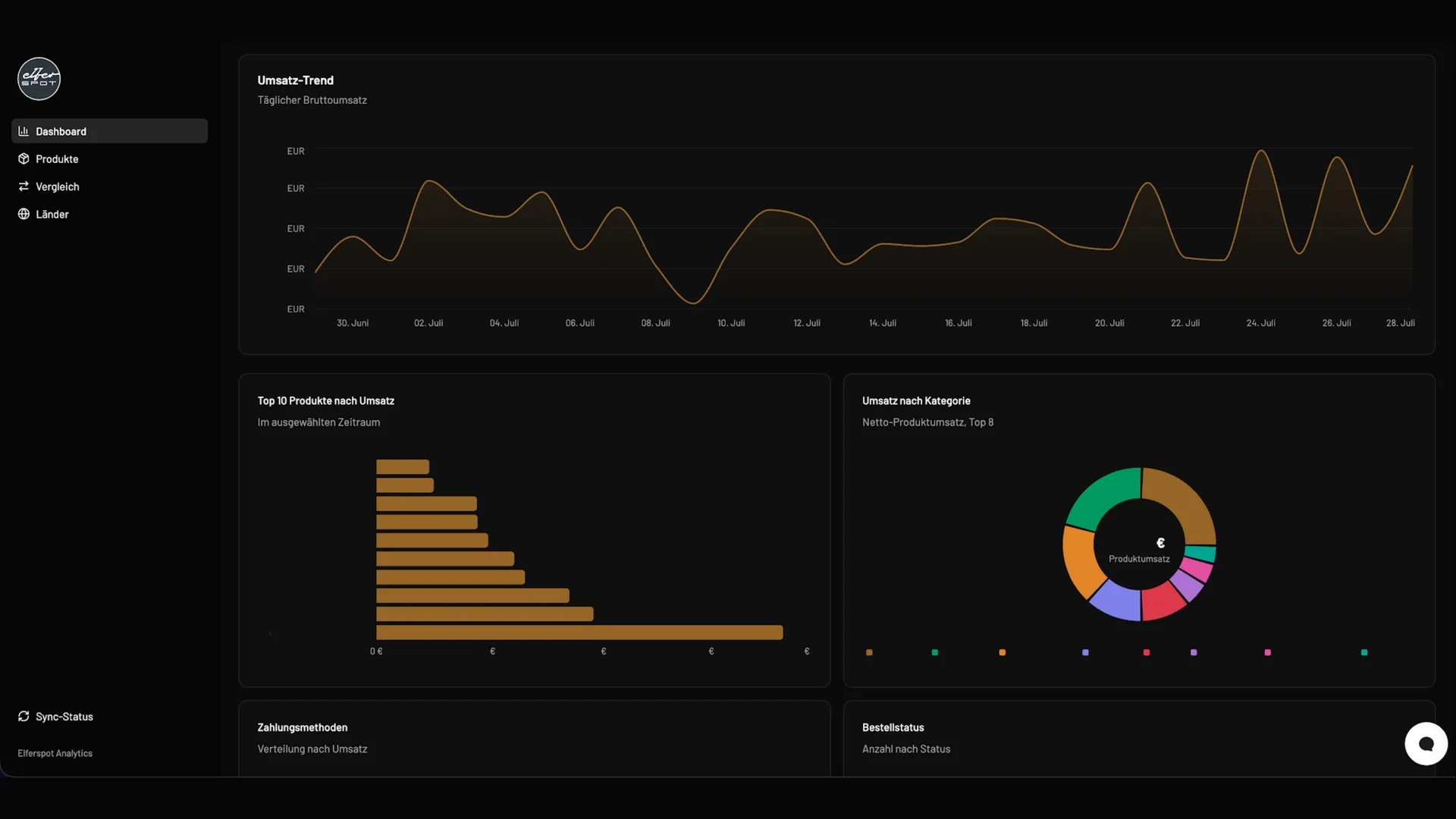
The goal behind it was simply put: Elferspot should no longer have to make gut decisions. Every reorder should be based on data, not on a feeling.
AI analysis and forecasting
A pure numbers dashboard shows what happened. The real value emerges where the system also says what is coming.
That's why the dashboard delivers an AI analysis and a forecast for all products. The system evaluates how a product is performing and derives an assessment of its upcoming development. This makes not only the current state visible, but also the likely trajectory.
“A good dashboard shows the inventory. An intelligent dashboard says when it will run out.”
This shifts reordering from a reactive to a forward-looking task. Not acting only when the shelf is empty, but when the forecast suggests it.
Alerts before it's too late
The most practical part of the system is the automatic alerts. Data only helps if it gets your attention at the right moment.
The dashboard speaks up on its own in two situations:
When inventory becomes critical. If stock falls below a defined threshold, the system warns, early enough that the reorder still works out given the supplier's lead time. Exactly where long delivery times would otherwise become a trap, the alert kicks in early.
When seasonal demand is ahead. If a large order volume is emerging for seasonal reasons, the system points it out before demand actually sets in. Elferspot can prepare instead of being surprised by a foreseeable rush.
These alerts are the point where an overview tool becomes a real assistant. The system doesn't wait for someone to check. It speaks up when a decision is due.
What this project shows
The Elferspot project is a good example of how AI in e-commerce doesn't have to be abstract. The benefit is very concrete: fewer sold-out products, less dead capital in the warehouse, fewer decisions made from the gut.
The key was bringing the right information together and adding a forward-looking layer. Analysis, forecast, and alerts interlock and remove exactly the uncertainty that a diverse supplier network brings.
That is our approach at Soneo AI. We build AI solutions that prove themselves in everyday use because they solve a real problem. At Elferspot, that's a dashboard that restores the overview and turns experience into a system that grows with the business.
Do you run a shop with many products, many suppliers, and too little overview? We'll show you how an intelligent dashboard derives the right decisions from your data.
Book a free initial consultationFAQ
What is an intelligent e-commerce dashboard?
An intelligent e-commerce dashboard brings all of a shop's relevant metrics together in one place: sales, inventory, and reorder needs. Unlike a pure reporting tool, it adds AI-supported analysis and forecasting to this data and actively warns when action is needed.
How does AI help with inventory management and reordering?
AI recognizes patterns in the sales of individual products and derives a forecast for their future development. This makes it possible to estimate when stock will run out. Combined with supplier lead times, the system can warn in time so reorders aren't triggered too late.
Why are different supplier lead times a challenge?
When an assortment is supplied by many small vendors and manufactories, every supplier has their own lead times. What one can deliver within days takes another weeks. Without a systematic overview, reordering becomes a tightrope walk between sold-out goods and tied-up capital.
How do the automatic alerts in the dashboard work?
The dashboard speaks up in two cases: when inventory falls below a defined threshold, in time for the supplier's lead time, and when increased demand is emerging for seasonal reasons. This allows reordering or preparing in time, before a shortage occurs.
Which companies is such a dashboard suitable for?
Especially online shops with a diverse assortment and many different suppliers, where reorder decisions have so far been based mainly on experience. The more products and the more varied the lead times, the greater the benefit of a system that combines overview, forecasting, and alerts.